
How Arrest Warrants Work in Brown County
Nebraska law puts criminal process in the hands of a county or district judge, with a clerk-magistrate holding limited authority. Once issued, an arrest warrant is directed to the sheriff, a city marshal, a police officer, or another officer the document names. Its command is simple: bring the accused before the issuing court or a proper magistrate. It is process tied to an accusation, nothing more. Brown County publishes no public arrest-warrant roster, no local warrant code, and no status feed. So run your Brown County warrant search in JUSTICE, sort out which court type you are dealing with, then phone the clerk. For service or custody questions in Brown County, ask the Sheriff's Office at 402-387-1440.
Probable Cause Starts the Court Record
An arrest warrant in Brown County starts with a complaint or sworn accusation plus a judicial probable-cause decision. The court file that follows can hold a charge, an affidavit, a case number, a warrant event, a bond instruction, a hearing date, and later entries showing recall or service. Those are separate events. A charge line is not a final result. The Nebraska process statute says who may issue criminal process, and § 29-406 spells out the command and its addressee. Brown County's clerk holds the case-specific answer.
| Complaint | A charging document or sworn accusation that starts a criminal case. |
|---|---|
| Probable cause | Facts that support a reasonable basis for the requested process. |
| Magistrate | A judicial officer with authority for specified preliminary or bail duties. |
Arrest Warrants: What They Contain
Brown County has posted no local sample warrant. State law and the Nebraska case system still show the fields a person needs to pin down a record. Ask for only the record you need, and keep private descriptors out of any public request.
| Warrant or case key | Case number or other court identifier. No Brown format was verified. Use CASE NUMBER as a field label, not a made-up code. |
|---|---|
| Issuing court | Brown County Court or Brown District Court, with the judicial officer when public. |
| Accusation | Charge or substance of the complaint, subject to access limits. |
| Command | Sheriff, city marshal, police officer, or another authorized officer. |
| Bond or release | PR, cash, 10% deposit, surety, or other court conditions may be listed. |
| Status event | Warrant, served, recalled, quashed, bond, hearing, or another docket entry. |
Brown County Arrest Records Have Two Sides
Arrest records in Brown County split into two halves. The clerk owns the court-side record. The sheriff owns service and custody. The county's comprehensive plan describes a medium-security jail holding pretrial and sentenced inmates, plus court-bailiff and dispatch work. It also says the jail takes inmates from surrounding municipalities, the Ainsworth Police Department, and the U.S. Marshals Service. That explains the coordination. It does not create a current arrest-warrant list or promise a walk-in process. Use Brown District Court for a felony or district matter and Brown County Court for a county-court case, then call the sheriff once the court names the right process. The district-court contact details come from the official Brown District Court page, which lists the court's own numbers and address.
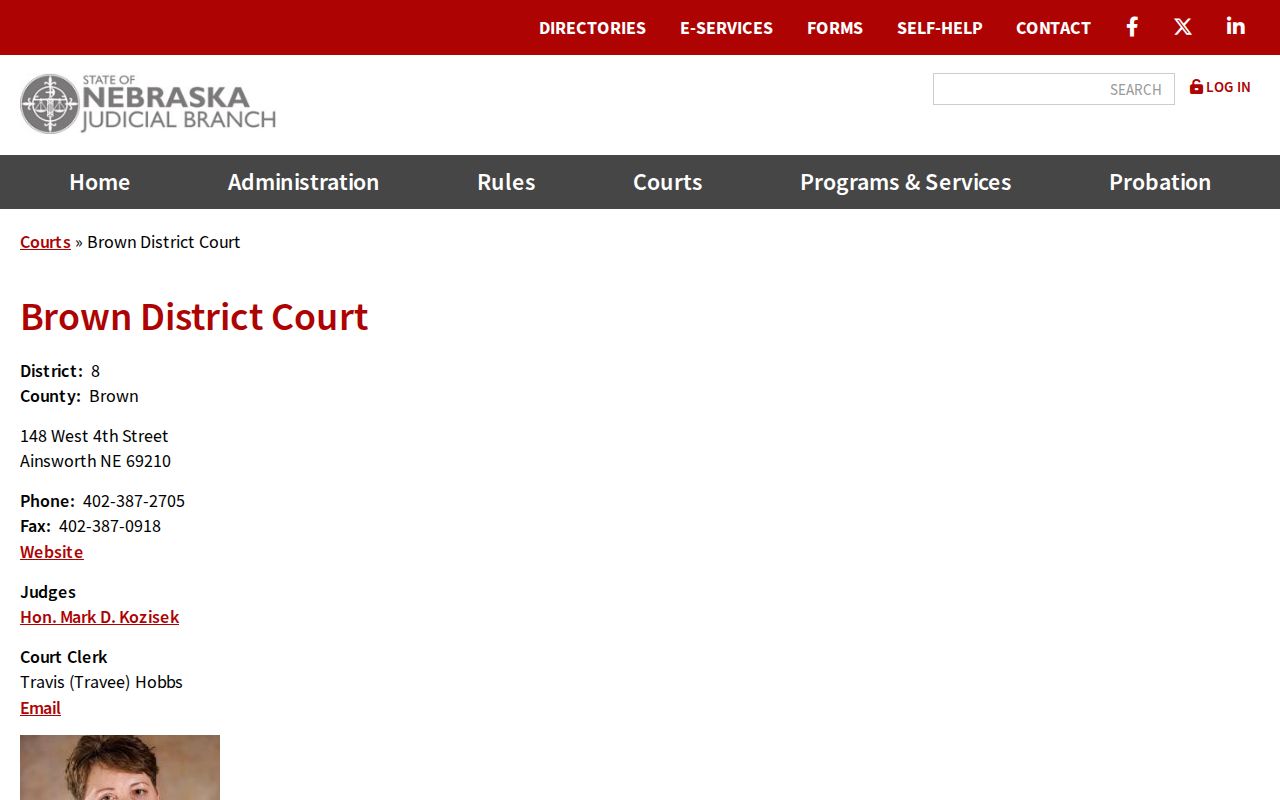
The court address and clerk route in Brown County are separate from the sheriff's address and the service route.
How Warrants Get Served in Brown County
Section 29-406 directs the process to the sheriff, or to a city marshal or police officer when the order says so. Which agency serves it depends on the document, the location, and the court's direction. Brown County's sheriff page lists 142 West 4th Street in Ainsworth and 402-387-1440. It names no warrant unit, no after-hours surrender rule, and no direct warrant line. Ask the clerk first whether the warrant is current, then ask the sheriff what service or custody information it can confirm. And never trust a phone number that arrives in an unsolicited message.
Arrest Warrants, Summonses, and Bench Warrants
These three forms of process are not the same thing. A summons asks a person to appear. An arrest warrant commands an authorized officer to take the person before court on the accusation and probable-cause process. A bench warrant usually follows a missed court obligation, contempt, or a breach of release conditions, and any Brown County warrant lookup should keep the three straight.
| Process | Typical source | Brown confirmation |
|---|---|---|
| Summons | Notice to appear without an arrest command. | Read the court notice and call the issuing clerk. |
| Arrest warrant | Complaint and probable-cause process. | County or district clerk, then sheriff or named officer. |
| Bench warrant | Missed appearance, payment, contempt, or release term. | Issuing court docket and sheriff service record. |
When Brown County Arrest Material Is Restricted
Search-warrant material plays by different access rules than arrest process. Under Neb. Rev. Stat. § 29-817, an application, affidavit, and testimony can stay nonpublic before execution. Juvenile records and active-investigation material may also be restricted in Brown County. Do not assume every arrest warrant is public, or that every search warrant is hidden.
Request rule: Ask the court or sheriff to cite the exception used for a denial and to release any separable, redacted portion.
For the request route in Brown County, use Nebraska's Public Records Act. The legal line belongs to the office holding the record.
Handling an Arrest Warrant in Your Name
Search JUSTICE by full name, Brown County, and court type. Open the register of actions and note the case number. Call the right clerk. Ask whether the warrant is current, whether a bond has been set, and whether counsel should arrange an appearance. Before traveling, call the sheriff to ask where service and custody questions are handled.
Next step: Ask an attorney and the issuing court about recall, quash, surrender, bond, or a scheduled hearing. Do not assume payment alone changes an arrest warrant.
Keep the order or docket entry that shows what changed in your Brown County case. JUSTICE can lag behind the court or service record.
Brown County Arrest Status Gaps
Brown County publishes no arrest-warrant count, live roster, update schedule, online clearance form, or surrender page. The county's official “Distress Warrants - Sheriff” link loops back to the sheriff contact page and is not a criminal search portal. A record request can still name a specific case, date, court, and status event, though the office may withhold investigative, juvenile, sealed, or other protected material. For the full search chain, use the Brown County warrant check instructions and keep the inquiry focused on a personal case.
Confirm the Court Action
A warrant in Brown County can sit in several states at once: served, recalled, quashed, superseded, or still active while the case moves ahead. Ask the issuing court which order or docket event controls it. Ask when that order took effect. The court's answer is the judicial status. The sheriff's answer is the service or custody status, and when its warrant record will update. Both can matter. One more caution: never repeat a private person's name, address, photograph, or physical description from a warrant. The useful public information is the route, the fields, and the limits.